


Understanding Mill Test Certificates for Copper Products
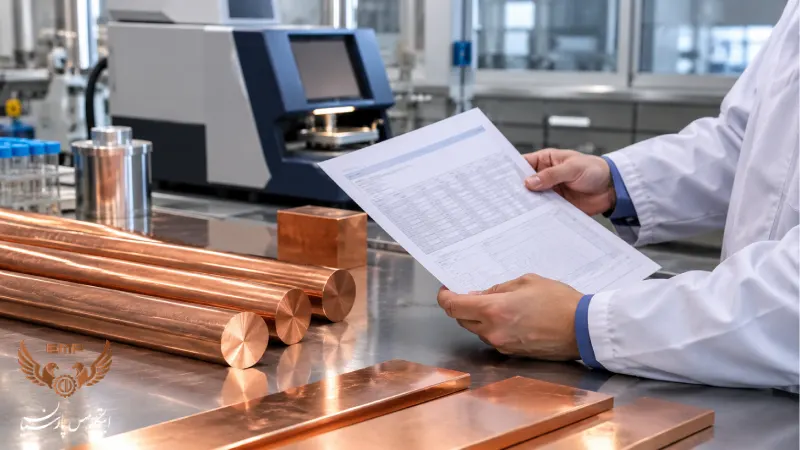
Imagine purchasing a batch of high-purity copper for a electrical project, only to discover after installation that its conductivity falls below the required standard. The copper may look flawless, but without reliable test records, there is no way to confirm that its chemical composition, mechanical properties, or production quality meet your specifications. This is where a Mill Test Certificate (MTC) becomes essential. More than a routine quality document, an MTC provides measurable evidence of a copper product’s compliance, origin, and traceability. For procurement and quality control professionals, knowing how to read and verify this certificate is a crucial step in avoiding costly material failures. In this guide, we’ll break down the key sections of a copper MTC, explain EN 10204 certification levels, and highlight the red flags to watch for before accepting a shipment.
What Is a Mill Test Certificate?
An MTC is issued by the producing mill and reports measured results for one production lot. Its value lies in what it proves, and in what its absence leaves exposed.
The Role of MTCs in QA/QC Compliance
The document confirms that a delivered lot meets the purchase contract and the referenced ASTM, ASME, or EN specifications. However, verifying these documents is only one part of the procurement process. Buyers must also consider factors such as chemical composition, mechanical properties, product dimensions, and applicable standards. These are among the essential Key Considerations for Purchasing Copper rod that help ensure the selected material meets project requirements. A Certificate of Compliance only states that the product conforms, while an MTC shows numbers measured on samples from the actual melt.
Operational Risks of Uncertified Copper
Without that paper trail, problems tend to surface only after installation:
- Conductivity loss from trace phosphorus, iron, or arsenic
- Porosity and cracking in joints when oxygen-bearing metal is brazed in a hydrogen-containing atmosphere
- Structural failure from strength values nobody confirmed
How to Read a Copper MTC
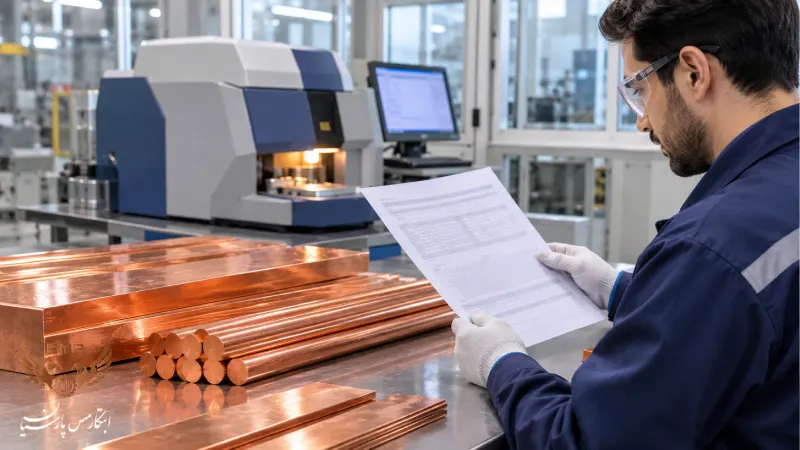
Every MTC follows a similar layout, and each block answers one question. If you only have time to check one thing, check the heat number.
1. Manufacturer Credentials and Heat Number Traceability
The header names the producing mill, its facility, the purchase order, and the product form, for example busbar under ASTM B187 or rod under EN 13601. Confirm that the named company actually produced the metal and is not a distributor.
Then walk to the bundle. Does the stencil, stamp, or tag match the cast number on the paper, character for character? Picture a lot of busbars tagged “H4471” with a certificate for “H4417.” One transposed digit, and the chemistry on the page describes a different melt. Reject the document until the mismatch is resolved.
2. Chemical Composition Analysis & Elemental Limits
Composition is reported in weight percent or ppm, usually measured by optical emission spectrometry. A common reading error is treating the specification column as test data, so look at the “actual measured” column. A certificate might show a 99.99% copper minimum with 99.994% measured, and oxygen at a 5 ppm maximum with 3 ppm measured. Every measured value, including sulfur, phosphorus, and iron, must sit inside the project limit.
3. Mechanical Properties Testing
This block lists tensile strength, yield strength at 0.2% offset, elongation, and hardness from room-temperature tests. Compare each figure with the range the specification sets for the ordered temper. A lot can pass on chemistry and still fail on ductility.
4. Temper Designation Codes (ASTM B187 / EN 13601)
The temper code records how the metal was processed, and it explains the mechanical values above:
- O60: soft annealed, used for flexible jumpers and windings
- H02: half-hard, common in switchgear busbars
- H04: hard drawn, chosen where rigidity matters
Confirm the certificate states the temper you ordered.
5. Dimensional Tolerances and Non-Destructive Testing (NDT)
Dimensions and thickness should be reported against tolerance limits. If the contract calls for hydrostatic or eddy current testing, the results belong on the document. A missing NDT line is a gap, not a pass.
6. Quality Stamp & Authorized Inspector Signature
A valid MTC carries the mill’s quality stamp, an authorized signature, and the stated inspection type. Without them it has no standing.
EN 10204 3.1 vs 3.2 Certificates
EN 10204 defines how independent the validating inspector is, and the contract should name the level required.
EN 10204 Type 3.1 Inspection Certificate
Type 3.1 is validated by the mill’s authorized representative, who is independent of the production department. For routine industrial busbars, rods, and coils, it is the usual requirement.
EN 10204 Type 3.2 Third-Party Inspection Certificate
Type 3.2 adds an accredited agency such as TÜV, SGS, Bureau Veritas, or Lloyd’s Register, which witnesses sampling and testing. In our view, large power transformers, offshore, and nuclear work justify the extra cost. Ordinary distribution hardware rarely does.
Quick Comparison Table: EN 10204 Inspection Types
The table below shows who validates each type and where it is typically used.
| Type | Document | Validated by | Typical use |
| 2.1 | Declaration of compliance | Manufacturer | Non-critical items |
| 2.2 | Test report | Manufacturer (non-specific testing) | Low-stress items |
| 3.1 | Inspection certificate | Mill’s independent inspector | Routine industrial supply |
| 3.2 | Inspection certificate | Mill inspector plus third party | High-risk projects |
Evaluating Oxygen-Free Copper (OFC) MTRs
For oxygen-free grades, two numbers deserve the most attention: oxygen content and conductivity.
Oxygen Purity Limits (≤ 5 ppm) and Hydrogen Embrittlement Immunity
ETP copper (C11000) holds roughly 200–600 ppm oxygen as cuprous oxide. Above about 400°C in a hydrogen-bearing atmosphere, hydrogen reacts with that oxide and forms steam at grain boundaries. The result is cracking.
Oxygen-free electronic copper (C10100 / CW009A) is limited to 5 ppm, and Cu-OF (CW008A) carries the same limit under EN 13601. UNS C10200 allows up to 10 ppm, so read the limit for your actual grade. For embrittlement, look for a passed test per ASTM B577.
Electrical Conductivity Standard (≥ 101% IACS)
Conductivity is reported as % IACS, where 100% equals 5.80 × 10⁷ S/m at 20°C. High-purity OFE copper reaches at least 101% IACS, with thermal conductivity near 390 W/m·K. Those margins lower I²R losses in transformer windings and generator components.
Red Flags Checklist
Certificates often pass through traders before reaching you, so scrutinize them as carefully as the metal. Warning signs include:
- A heat number that differs from the physical marking
- Chemistry values that are suspiciously round, such as exactly 99.90%
- Missing stamps or signatures
- Absent NDT data where the contract requires it
- A type 2.2 report offered in place of 3.1 or 3.2
- A distributor listed as the producing mill
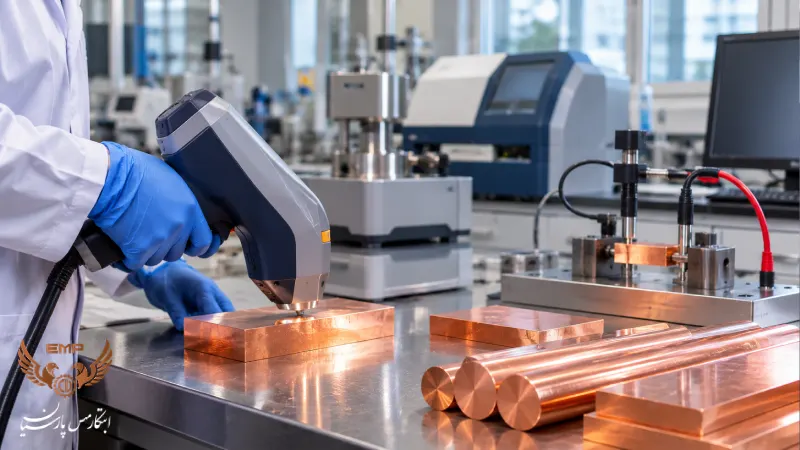
Real spectrometer readings vary in the third and fourth decimal. When something looks off, ask for the raw spectrometer output and the original mill certificate.
Conclusion & Procurement Guidance
Treat the MTC as a test of the shipment, not a formality. Heat number, measured chemistry, temper, and inspection level together show whether the lot matches the contract. When technical procurement managers evaluate Copper products from Iran, requiring a traceable EN 10204 3.1 or 3.2 certificate, backed by spectrographic analysis and verified heat numbers, is an effective way to reduce the risk of receiving non-conforming materials.
FAQ
What is the difference between a mill test certificate and a certificate of compliance?
An MTC reports values measured on samples from the actual melt, while a certificate of compliance only states that the product meets the order.
Is an EN 10204 3.1 certificate enough for copper busbars?
For routine industrial busbars, yes; choose 3.2 only when the contract or project code requires an independent third-party inspector.
What oxygen level should an OFE copper MTC show?
Oxygen-free electronic copper (C10100) must report 5 ppm or less.