


How to check copper rod purity 99.99?
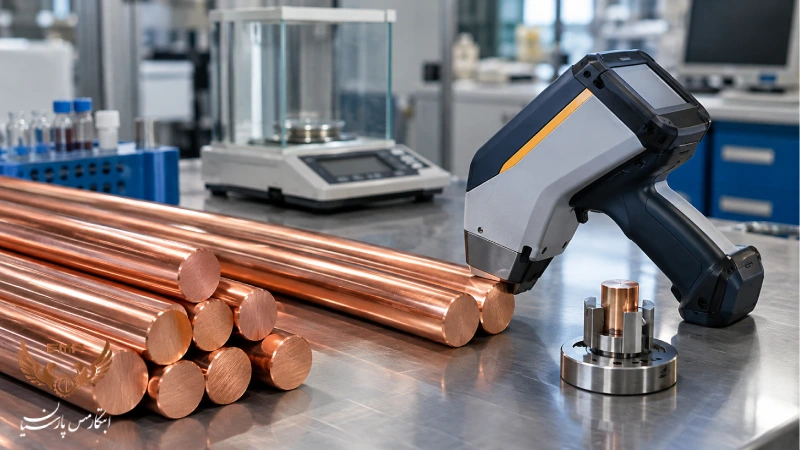
Verifying that a copper rod really is 99.99% pure takes more than reading a mill certificate. Quality control engineers and procurement managers need a layered approach: fast electrical screening at the receiving dock, then trace-element confirmation in an accredited laboratory. This guide covers the standards, methods and decision points involved in testing purity of copper rod stock.
What Does 99.99% (4N) Copper Rod Purity Mean?
In industry shorthand, 99.99% purity is “4N” (four nines) copper. It corresponds to UNS C10100, known as Oxygen-Free Electronic (OFE) copper, specified under ASTM B170 Grade 1 (Cu-OFE / CW009A in EN standards). The table below shows how it differs from the common commercial grade.
| Property | OFE copper (C10100) | ETP copper (C11000) |
| Typical purity | ≥ 99.99% Cu | ≥ 99.90% Cu |
| Oxygen content | ≤ 5 ppm (0.0005%) | 200–400 ppm (0.02–0.04%) |
| Minimum conductivity | ≥ 101% IACS | ≥ 100% IACS |
| Hydrogen embrittlement risk | Negligible | Significant above ~400 °C in H₂ |
| Typical use | Fine wire, electronics, vacuum devices | Building wire, busbars, general cable |
IACS (International Annealed Copper Standard) sets 100% at 58.0 MS/m at 20 °C, so 101% IACS equals about 58.6 MS/m.
Why Testing Purity of Copper Rods Matters
Purity problems rarely show up at the rod mill. They show up downstream, as broken wire, overheated coils or cracked brazed joints. The main failure modes are:
- Wire breaks in fine drawing: hard cuprous oxide (Cu₂O) particles and other inclusions concentrate stress as the cross-section shrinks, causing breaks, downtime and scrap.
- Higher resistive loss: dissolved impurities scatter electrons, lowering conductivity and increasing I²R heating in transformers, generators and high-frequency coils.
- Hydrogen embrittlement: in bright annealing, brazing or welding under hydrogen, the gas reacts with Cu₂O to form steam, which causes micro-cracks and voids.
The impurity elements most often scrutinized in 4N material have distinct effects, summarized below.
| Impurity | Main effect on rod performance |
| Oxygen | Forms Cu₂O; drives embrittlement and drawing breaks |
| Bismuth, lead | Segregate to grain boundaries; cause hot shortness and reduced ductility |
| Selenium, tellurium | Reduce conductivity and annealing behavior even at low ppm |
| Sulfur, phosphorus | Reduce conductivity; phosphorus also affects hydrogen-atmosphere behavior |
| Iron | Degrades conductivity and can introduce magnetic inclusions |
C10100 sets very low per-element limits for these species, typically single-digit ppm. Always check them against the current edition of ASTM B170 rather than a summary table.
Industry Standards Governing Copper Rod Quality
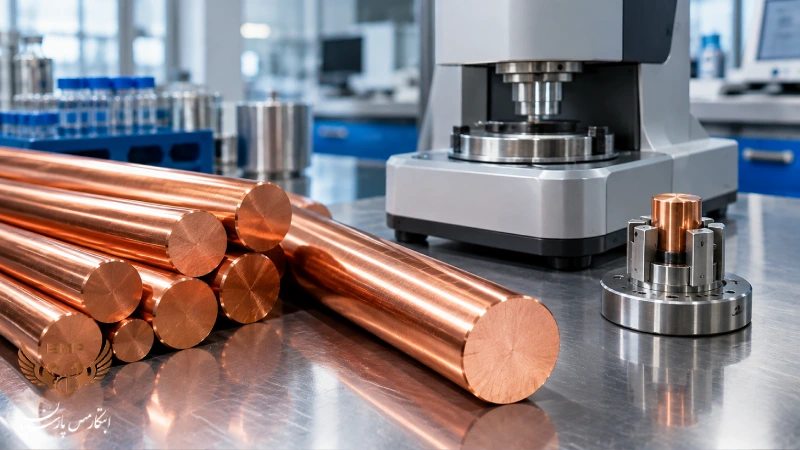
ASTM B49 (Standard Specification for Copper Rod for Electrical Purposes) is the benchmark for copper drawing stock. It covers rod from 1/4 in. to 1-3/8 in. (6.4 to 35 mm) and acts as the qualification gate before rod is drawn into wire under ASTM B1, B2 and B3. Full verification draws on several companion standards:
| Standard | What it verifies |
| ASTM B49 | Chemical, electrical and mechanical requirements for rod stock |
| ASTM B170 | Composition limits for oxygen-free copper grades, including C10100 |
| ASTM B193 | Resistivity and conductivity measurement |
| ASTM B577 | Hydrogen embrittlement susceptibility |
| ASTM E53 | Electrogravimetric determination of copper (referee method) |
| ISO/IEC 17025 | Competence of the laboratory issuing the certificate |
Non-Destructive Testing Methods for Oxygen Free Copper Purity
The testing methods for oxygen free copper purity below let you screen a lot quickly before committing to laboratory analysis.
Eddy current conductivity testing
Eddy current instruments such as the SIGMATEST measure electrical conductivity directly on solid rod and report the result in % IACS or MS/m. At high frequencies (up to 960 kHz) the penetration depth is very shallow, so readings reflect the surface layer. That makes it useful for small-diameter rods, but if the buyer and supplier might disagree about whether the shipment meets specification, a surface reading should be backed by a bulk method.
Resistivity bridge measurement (ASTM B193)
Specimens are annealed, held at a controlled temperature, and measured by DC micro-ohmmeter to calculate volume resistivity. This is the reference method for confirming the ≥ 101% IACS requirement.
Hydrogen embrittlement test (ASTM B577)
Samples are heated in a hydrogen atmosphere, then bent and examined metallographically for voids or grain-boundary cracking. Passing this test is strong indirect evidence of low oxygen, because embrittlement is driven by residual Cu₂O.
Mechanical and physical checks
These checks catch gross problems cheaply:
- Tensile and elongation: test annealed specimens (conditioned at 850 °C ± 25 °C) to confirm ductility for drawing.
- Density: copper’s specific gravity is about 8.96 g/cm³; hydrostatic weighing flags porosity or alloying.
- Magnet test: pure copper is non-magnetic, so a strong magnet can reveal ferrous contamination.
None of these methods quantifies individual trace elements. They indicate whether a rod behaves like 4N copper, not whether its chemistry proves it.
Detecting Impurities in OFC Copper Rods: Laboratory Techniques
At 99.99% purity, each contaminant sits at the ppm or ppb level, so detecting impurities in OFC copper rods requires ultra-sensitive instruments. The four core techniques are compared here.
| Technique | What it does | Strength |
| Triple-quad ICP-MS (e.g. Agilent 8900 ICP-QQQ) | Quantifies up to ~49 trace elements (alkali metals, Si, P, S, Bi, Pb, Se, Te, As, Sb) in one run | Sub-ppb detection limits; collision/reaction cell (O₂/H₂) suppresses interferences such as ArCu⁺ |
| ETV-ICP-OES | Vaporizes trace elements away from the copper matrix, using halogenating modifiers (CHF₃, SF₆, NF₃) or H₂/Ar for Se and Te | Limits of quantitation below 0.1 mg/kg for difficult elements |
| Electrodeposition (ASTM E53) plus AAS | Plates copper onto a platinum cathode; AAS measures the small residual left in solution | Referee method for total Cu content |
| Spark OES | Direct multi-element analysis of the solid sample in seconds | Fast bulk checks in cast houses and plant labs |
For ICP-MS, the sample is typically digested in high-purity nitric acid and diluted to roughly 0.1% Cu, which keeps matrix effects manageable while preserving ppb-level sensitivity.
A practical point for buyers: 99.99% is usually established indirectly. Labs measure the impurities and subtract, or confirm total copper by electrogravimetry. Ask the lab which approach it used, because the two can differ at the margin.
Field Screening vs. Accredited ISO 17025 Laboratory Analysis
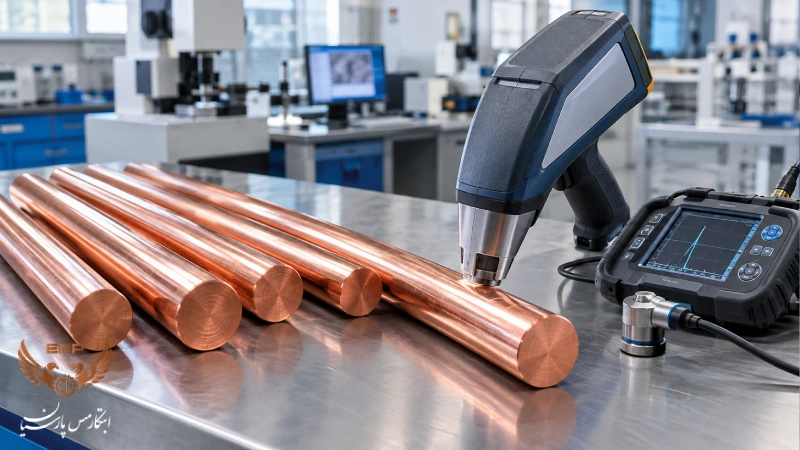
Field tools and laboratory methods answer different questions, and confusing them is a common source of disputes. The table summarizes where each belongs.
| Aspect | Portable field screening | ISO/IEC 17025 laboratory |
| Typical tools | Handheld XRF (e.g. Bruker TITAN), portable eddy current | ICP-QQQ, ETV-ICP-OES, ASTM E53 setup |
| Detection capability | Alloy ID and sorting; limited for sub-ppm trace levels | Sub-ppm to ppb quantification |
| Best use | Receiving checks, grade identification, scrap sorting | Official 4N certification, supplier requalification, dispute resolution |
| Sample impact | Non-destructive | Micro-sample digestion or spark ablation |
| Documentation value | Screening record only | Legally defensible certificate of analysis |
Field tools and laboratory methods answer different questions, and confusing them is a common source of quality disagreements between buyers and suppliers.
Receiving Inspection Checklist for 99.99% Copper Rod
When a shipment of C10100 rod arrives, a four-step protocol balances speed and rigor:
- Visual and dimensional inspection: check surface finish, roundness, diameter tolerance (6.4–35 mm under ASTM B49) and the absence of laps or surface oxide.
- Conductivity screening: run eddy current testing and confirm ≥ 101% IACS (about 58.6 MS/m).
- Hydrogen embrittlement compliance: confirm lot samples pass ASTM B577 without grain-boundary cracking or voids.
- Certified trace analysis: obtain an ISO/IEC 17025 report (ICP-QQQ, ETV-ICP-OES or ASTM E53) confirming Cu ≥ 99.99% and oxygen ≤ 5 ppm.
For commercial investigation, a few questions separate reliable suppliers from risky ones. Supplier evaluation should include checking material specifications, batch traceability, and the range of Copper products from Iran available for the intended application.
- Does the certificate list per-element results, or only a single “Cu ≥ 99.99%” statement?
- Is the lab ISO/IEC 17025 accredited for this specific test method?
- Is the certificate traceable to your heat or lot number?
- If you and the supplier disagree about the shipment’s quality, will the supplier accept independent third-party verification?
When evaluating a supplier, buyers should also confirm that the offered material matches their required copper grade and intended application, particularly when planning to Buy Copper Concentrate in Bulk from Iran.
Conclusion
Verifying 99.99% copper rod is a staged process. Conductivity and hydrogen embrittlement tests show quickly whether the material performs like oxygen-free copper, while accredited trace-element analysis provides the proof you can rely on contractually. Anchoring each step to ASTM B49, B193 and B577, and requiring an ISO/IEC 17025 certificate for the final decision, protects your drawing line, your product quality and your purchasing position.
FAQ
What does 101% IACS mean?
IACS sets annealed copper at 100% (58.0 MS/m at 20 °C). C10100 must reach at least 101%, about 58.6 MS/m.
Why does oxygen cause cracking at high temperatures?
In hydrogen atmospheres, hydrogen reacts with Cu₂O to form trapped steam, which creates micro-cracks. That is why C10100 limits oxygen to 5 ppm.
Can handheld XRF confirm 99.99% purity?
No. It identifies the alloy but cannot measure ppm-level impurities. Official 4N proof needs an ISO/IEC 17025 lab report.