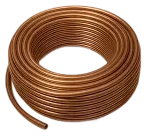


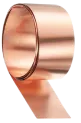
Oxygen-Free Copper Strip 6×6
Thickness 6 × Width 6 mm · Copper 99.99% · Conductivity over 100% IACS
Technical Specifications
| Size | 6 × 6 mm |
|---|---|
| Width | 6 mm |
| Copper Content | Min. 99.99% |
| Oxygen | Max. 10 ppm |
| Electrical Conductivity (20°C) | More than 100% IACS |
| Grade | OFE Copper per ASTM B49 (C10200) |
| Tensile Strength | 240 N/mm² |
| Elongation | More than 35% |
| Hardness | 40 to 100 HV |
| Density | 8.94 g/cm³ |
| Thickness | 6 mm |
| Length | 3,000 to 6,000 m |
| Coil Inner Diameter | 85 cm |
| Coil Outer Diameter | 165 cm |
| Weight per Coil | 1.5 to 2.5 tons |
| Packaging | On a 1.8 × 1.8 m wooden pallet with plastic wrapping |
| Standard | ASTM B187 / EN13601 |
Product Description
Oxygen-Free Copper Strip is produced with a minimum purity of 99.99% and a maximum oxygen content of 10 ppm, in compliance with ASTM B187 and EN13601 standards, offering stable and reliable performance across a wide range of industrial applications.
Lorem ipsum dolor sit amet, consectetur adipiscing elit, sed do eiusmod tempor incididunt ut labore et dolore magna aliqua.
Applications
- Transformers and power distribution equipment
- Electrical connections and busbar work
- Electronics and telecommunications industries
- Automotive manufacturing and hybrid systems
Key Advantages
- Electrical conductivity exceeding 100% IACS
- Tensile strength of 240 N/mm²
- Controlled hardness of 40 to 100 HV
This section can be customized with more detailed product information, certifications, and application case studies.
The 6×6 mm size in copper busbars is a special, thick square section designed for transferring high, stable electrical currents — where even the smallest voltage drop or metal impurity comes at the cost of reduced efficiency for the entire system. At Ebtekar Mes Parsian Industrial Group (EMP), the 6×6 mm copper busbar is manufactured and supplied with 99.99% purity in OFC (oxygen-free) grade to deliver the highest electrical conductivity for sensitive busbar lines and power equipment. To select the most precise size and receive a lab analysis certificate, you can contact EMP’s technical experts directly.
6×6 mm Copper Busbar Price and the Factors Behind It
Due to its square cross-section and widespread use in heavy electrical equipment, the 6×6 mm copper busbar is one of the most commonly used sections in the power industry. Determining its final price depends on several technical and economic factors, and understanding them helps purchasing managers and technical experts make the best decision based on project priorities.
Daily 6×6 mm Copper Busbar Price
The basis for pricing copper busbars in the market is the net weight of the load in kilograms. The base copper price depends on the daily global rate on the London Metal Exchange (LME) and the base price on the Iran Mercantile Exchange. However, this product is traded in two ways:
- Price per kilogram (base transaction): The most transparent pricing method, calculated by multiplying the exact weight of the delivered batch by the day’s copper rate, plus the manufacturing/rolling fee.
- Price per bar: For construction or switchgear projects, the price is calculated based on standard length (usually 4 meters). Each 4-meter bar weighs approximately 1.28 kg, and its price is obtained by multiplying this weight by the day’s per-kilogram rate.
For real-time pricing and to place an order by the bar or by coil, you can contact the sales department at Ebtekar Mes Parsian Industrial Group (EMP).
The Effect of Copper Purity Percentage on Price
One of the most important factors behind price differences in the market is the grade and purity percentage of the copper metal:
- Standard copper (ETP / C11000): Has a purity of about 99.90% and an oxygen content between 100 and 400 ppm. This grade has a lower production cost but is more susceptible to hydrogen embrittlement and oxidation.
- Oxygen-free copper (OFC / C10200): Manufactured with 99.99% purity and a maximum oxygen content of 10 ppm. The melting and solidification process under vacuum or protective gas increases the production cost of OFC busbars, but electrical conductivity above 101% IACS, excellent flexibility, and resistance to embrittlement during welding and soldering make the higher price fully economical and justified.
Technical Specifications of the 6×6 mm Copper Busbar
The 6×6 mm copper busbar has a cross-sectional area of 36 mm². This section provides suitable current-carrying capacity alongside acceptable mechanical strength and is used in industrial power applications and electrical panels.
Weight per Meter of 6×6 mm Copper Busbar
The standard density of pure copper is 8.94 g/cm³ (or 8,940 kg/m³). The following formula is used to calculate the weight of one meter of this busbar:
Formula: Weight per meter (g) = Thickness (mm) × Width (mm) × Length (m) × Density
Calculation:
6 × 6 × 1 × 8.94 = 321.84 grams per meter
Dimensional and weight specifications:
- Cross-section: 6 × 6 mm (36 mm²)
- Weight per meter: 321.8 g (about 0.322 kg)
- Weight of a 4-meter bar: about 1.287 kg
- Standard coil weight: 1.5 to 2.5 tons (per order)
Allowable Current-Carrying Capacity of the 6×6 mm Copper Busbar
The current-carrying capacity of a copper busbar depends on several factors. Cross-sectional area, ambient temperature, installation conditions, ventilation level, the number of adjacent busbars, and current duration are all factors that affect current capacity.
For a 6×6 mm copper busbar with a 36 mm² cross-section, the continuous current capacity should be determined based on actual installation conditions. The following approximate values can be used for an initial estimate:
- Installed in open air at an ambient temperature of about 25°C: approximately 160 to 180 amps
- Installed inside a switchgear panel at about 35–40°C: approximately 130 to 150 amps
- Short-circuit current: the tolerable value depends on fault duration, the conductor’s initial temperature, and installation conditions.
The figures above are for preliminary estimation only; the final selection of a copper busbar or bar should be based on a review of the thermal conditions and standard requirements specific to that equipment.
Physical and Mechanical Properties of the 6×6 mm Copper Busbar
The properties of a copper busbar depend on the copper’s purity and its metallurgical state — whether soft, half-hard, or hard. The ASTM B187 and EN 13601 standards are the reference standards used for the specifications of copper products used in electrical applications.
The declared technical specifications for EMP’s 6×6 mm copper busbar are as follows:
| Technical Index | Value |
| Electrical conductivity | Above 100% IACS, up to about 101% |
| Tensile strength | About 240 N/mm² |
| Elongation | Above 35% |
| Hardness | About 40 to 100 HV |
| Cross-section | 36 mm² |
High electrical conductivity reduces the conductor’s electrical resistance and limits energy losses. Elongation above 35% also indicates the busbar’s suitable capability for forming and bending operations under the manufacturer’s specified conditions.
Hardness values depend on the busbar’s production condition and can vary based on whether it is annealed or hard-tempered. For this reason, when purchasing or ordering a copper busbar, it’s important to specify the copper grade, metallurgical condition, and required standard.
Types of 6×6 mm Copper Busbar by Alloy and Structure
Copper busbars are categorized based on the manufacturing process, physical state, and edge geometry to cover different industrial needs.
Oxygen-Free 6×6 mm Copper Busbar (OFC)
In this grade (C10200 / OFE), oxygen has been removed to below 10 ppm. The uniform microscopic structure and 99.99% purity mean these busbars do not suffer from embrittlement in hydrogen-containing environments and provide the highest thermal and electrical conductivity for sensitive equipment.
6×6 mm Copper Busbar in Bars (4-meter/Hard) and Coils (Rolled/Annealed)
- Bars (Hard/Half-Hard): Supplied in lengths of 3 to 6 meters. Due to their structural rigidity, they are suitable for straight busbar runs in switchgear panels, power transmission routes, and regular assemblies.
- Coils/Rolls (Soft/Annealed): Subjected to annealing heat treatment and highly flexible. This type is supplied in large coils with an internal diameter of 85 cm and a weight of 1.5 to 2.5 tons, and is used for winding transformers and induction furnaces that require repeated bending.
Rounded-Edge and Square-Edge Copper Busbar
- Square Edge: Has full 90-degree corners and is suitable for bolted connections or precision machining.
- Rounded Edge: Corners have a standard curvature. This curvature reduces electric field concentration (reducing the corona effect) at high voltages and prevents damage to insulation around the busbar.
Main Industrial Applications of the 6×6 mm Copper Busbar
Due to its proportional surface-to-volume ratio and high strength, the 6×6 mm square section is used across numerous sectors of the power and metallurgy industries.
- Busbar wiring for industrial and distribution switchgear panels: In low- and medium-voltage electrical panels, the 6×6 busbar is used as a sub-busbar, interconnecting bar, and current distribution bar. Its square cross-section makes regular layout and secure connection of cable lugs and switches easier.
- Grounding, lightning protection, and bonding systems: Due to copper’s exceptional resistance to soil corrosion and high electrical conductivity, the 6×6 busbar is a standard option for lightning protection down-conductors and grounding bonding networks in substations and industrial facilities.
- Manufacturing transformers, electric motors, and induction furnaces: In high-voltage transformer windings, induction furnace coils, and industrial electric motor manufacturing, the annealed (coiled) 6×6 busbar is a key component due to its high formability and retention of purity through tight bends.
Buying Guide: Points to Consider Before Ordering 6×6 mm Copper Busbar
Purchasing copper equipment requires attention to technical detail to avoid financial losses and reduced project quality.
How to distinguish high-quality, pure copper from scrap:
- Color and surface appearance: Pure copper has a bright reddish color and a uniform surface free of porosity, cracks, or dark oxide stains.
- Mill Test Certificate: Always check the analysis certificate accompanying the shipment. EMP products guarantee a minimum purity of 99.99% and conductivity above 101% IACS.
- Bend test: High-quality, annealed copper bends smoothly and does not develop hairline cracks on the outer surface of the bend.
The Importance of Dimensional Tolerance in Busbar Quality
Dimensional deviation in the busbar’s thickness or width (for example, 6.2 or 5.8 mm instead of 6.0 mm) causes asymmetry in contact surfaces and creates unwanted electrical resistance at connection points. According to ASTM B187 standards, dimensional tolerance should be controlled within a tenth of a millimeter.
How to Calculate the Length and Weight Needed for a Project
To determine order volume:
- Determine the total length of the busbar run or winding in meters.
- Multiply the length figure by 0.322 (the weight of one meter of 6×6 busbar in kilograms).
- Add 5–7% to the final weight to account for waste and cutting.
FAQ
How much does a 4-meter bar of 6×6 mm copper busbar weigh?
Based on copper’s standard density (8.94 g/cm³), each 4-meter bar weighs approximately 1.28 kg.
What is the current-carrying capacity of a 6×6 mm copper busbar?
Under standard ambient conditions (25°C) in open air, this busbar can carry a continuous current of approximately 160 to 180 amps.
What’s the main difference between a 6×6 mm copper busbar and rectangular sizes (such as 15×3)?
The 6×6 busbar has a square cross-section, which provides uniform bending strength in all directions, while rectangular sizes like 15×3 are designed for wider connections and greater heat exchange surface area — even though both have the same cross-sectional area (36 mm²).
Can a quality analysis certificate be provided for the buyer’s shipment?
Yes, all batches delivered by Ebtekar Mes Parsian Industrial Group (EMP) come with a dedicated lab analysis certificate based on ASTM standards.