


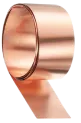
Oxygen-Free Copper Strip 6×5
Thickness 6 × Width 5 mm · Copper 99.99% · Conductivity over 100% IACS
Technical Specifications
| Size | 6 × 5 mm |
|---|---|
| Width | 5 mm |
| Copper Content | Min. 99.99% |
| Oxygen | Max. 10 ppm |
| Electrical Conductivity (20°C) | More than 100% IACS |
| Grade | OFE Copper per ASTM B49 (C10200) |
| Tensile Strength | 240 N/mm² |
| Elongation | More than 35% |
| Hardness | 40 to 100 HV |
| Density | 8.94 g/cm³ |
| Thickness | 6 mm |
| Length | 3,000 to 6,000 m |
| Coil Inner Diameter | 85 cm |
| Coil Outer Diameter | 165 cm |
| Weight per Coil | 1.5 to 2.5 tons |
| Packaging | On a 1.8 × 1.8 m wooden pallet with plastic wrapping |
| Standard | ASTM B187 / EN13601 |
Product Description
Oxygen-Free Copper Strip is produced with a minimum purity of 99.99% and a maximum oxygen content of 10 ppm, in compliance with ASTM B187 and EN13601 standards, offering stable and reliable performance across a wide range of industrial applications.
Lorem ipsum dolor sit amet, consectetur adipiscing elit, sed do eiusmod tempor incididunt ut labore et dolore magna aliqua.
Applications
- Transformers and power distribution equipment
- Electrical connections and busbar work
- Electronics and telecommunications industries
- Automotive manufacturing and hybrid systems
Key Advantages
- Electrical conductivity exceeding 100% IACS
- Tensile strength of 240 N/mm²
- Controlled hardness of 40 to 100 HV
This section can be customized with more detailed product information, certifications, and application case studies.
In switchgear and power distribution projects, the quality of copper busbars has a direct impact on the safety and service life of equipment. If you’re looking to buy a high-purity 5×6 mm copper busbar and need real-time pricing on OFC copper, Ebtekar Mes Parsian Industrial Group supplies this critical component directly, with no intermediaries. Using copper with genuine purity not only prevents voltage drop but also minimizes hidden repair costs and energy losses. Below, we cover the full technical specifications, pricing methodology, and ordering guide for this product.
5×6 mm Copper Busbar Price and the Factors Behind It
Copper is one of the world’s most strategic commodities, which is why the final cost of copper products — including the 5×6 mm busbar price — follows both a global and domestic pricing chain:
- The role of the London Metal Exchange (LME): The base price of copper worldwide is set by trading on the London Metal Exchange. Any shift in global supply and demand immediately moves the price per ton or kilogram of raw copper, and that effect quickly passes through to domestic markets.
- Cathode supply on the Iran Mercantile Exchange: Iranian manufacturers (such as National Iranian Copper Industries) purchase their raw material — copper cathode — through the Iran Mercantile Exchange at the day’s rate, which reflects a combination of the global LME price and the free-market exchange rate.
- Conversion costs: The final busbar price is the sum of the day’s exchange-traded copper rate plus manufacturing process costs (melting, extrusion, drawing, straightening, and quality control).
How the Price per Kilogram and per Bar Is Calculated
The cost of a 5×6 mm copper busbar is calculated using a fully transparent formula, so project managers can get an accurate cost estimate before placing an order. This pricing consists of two main components:
- Base raw material rate: The day’s copper price, determined directly by cathode copper trading rates on the Iran Mercantile Exchange and in global markets (LME).
- Manufacturing service cost: The cost of production processes including drawing, forming, and section preparation.
Calculating the price per bar: To determine the final price, the weight per unit length of the product (each meter of 5×6 mm busbar weighs approximately 268 grams, based on copper’s density) is multiplied by the bar’s length and then by the day’s price per kilogram of copper. This transparent structure lets you forecast switchgear and electrical project costs with no ambiguity.
The Value of High-Purity (OFC) Busbars
OFC busbars, with purity above 99.99%, offer outstanding electrical conductivity (over 101% IACS). While the upfront price may be slightly higher, by preventing coil overheating and energy losses, they significantly reduce your long-term secondary costs.
Technical Specifications of the 5×6 mm Copper Busbar
When choosing a 5×6 mm copper busbar for power circuits or grounding systems, guesswork isn’t an option. A precise analysis of this section’s behavior helps you avoid hidden voltage drop in the network and optimally manage the equipment’s dead load.
Key Comparison: OFC Copper Busbar vs. Standard Copper
| Technical & Commercial Feature | Oxygen-Free Copper (OFC) Busbar | Standard Copper Busbar |
| Copper purity | Above 99.99% | About 99.9% |
| Electrical conductivity (IACS) | Above 101% | About 100% |
| Manufacturing standard | Compliant with ASTM B49/B187 and EN 13601 | Miscellaneous or workshop-grade standards |
| Mechanical strength & bending | Homogeneous structure, free of gas pockets (ideal for tight bends) | Risk of micro-cracking on sharp bends |
| Durability in service conditions | Long service life, stable under thermal stress | Faster degradation under continuous dynamic loads |
| Long-term economic advantage | Significant energy savings, eliminates hidden repair/replacement costs | Hidden costs from heat loss and voltage drop |
| Main applications | Sensitive switchgear panels, power circuits, transformers | General, low-sensitivity applications |
Weight per Unit Length and Calculating Busbar Footage
To make length and cost calculations easier, knowing the weight per meter of this busbar is very useful. Given the 5×6 mm dimensions and the density of pure copper (about 8.94 g/cm³), each meter of this busbar weighs approximately 268 grams.
With this simple figure, you can easily calculate the total weight of the bars you need, assess the load on the switchgear panel’s structure, and get a more accurate estimate of shipping and purchase costs before buying.
Allowable Current Rating (Amperage) of the 5×6 mm Copper Busbar
The 30 mm² cross-section of this busbar provides a defined capacity for carrying electrical current in power circuits. The allowable amperage for this section depends directly on installation conditions — whether the busbar is installed in open air or inside an enclosed switchgear panel — as well as the permitted temperature rise. This size delivers fully stable performance for medium currents in distribution circuits, with no unauthorized voltage drop and minimal heat loss.
Electrical Resistance and Alloy Standards
These busbars are manufactured to internationally recognized standards such as ASTM B187 and EN 13601, ensuring the internal copper structure is completely uniform and free of any voids or impurities.
Thanks to their very high purity (OFE grade, above 99.99% purity, with oxygen content below 10 ppm), electrical resistance in this product is kept to a minimum. This means your system experiences minimal energy and heat loss, and — combined with adequate tensile strength — forms connections that are safe and durable against vibration and continuous heavy loads.
Types of 5×6 mm Copper Busbar by Appearance and Manufacturing Process
Choosing the right type of copper busbar isn’t just about appearance — the manufacturing technology and base material also determine performance quality, durability, and current-carrying efficiency in industrial projects.
Oxygen-Free Copper (OFC) Busbar: Our Flagship Product
The oxygen-free copper (OFC) busbar is our company’s core, flagship product, manufactured with exceptionally high purity (above 99.99%). During production, oxygen and gaseous impurities are completely eliminated, keeping the internal copper structure fully uniform. This structural characteristic maximizes electrical conductivity and sharply reduces energy and heat losses in power circuits. If long-term system stability and equipment safety are your priorities, this specialized section is the best choice.
Radius Edge vs. Square Edge Copper Busbar
Square-edge busbars have sharp, angular edges and are typically used for simple connections or spaces that don’t require complex forming. Radius-edge busbars, by contrast, are manufactured with rounded edges to reduce stress concentration during bending. This feature prevents cracking and improves insulation safety in tight switchgear panel spaces.
Tin-Plated and Braided Copper Busbars (Specialty Applications)
In addition to standard models, tin-plated or braided versions are more effective options for environments exposed to moisture, chemical corrosion, or continuous mechanical vibration — such as connections to transformers and generators.
Main Industrial Applications of the 5×6 mm Copper Busbar
The engineered dimensions and rectangular cross-section of the 5×6 mm copper busbar have made it a key, widely used component across various electrical and utility industries. Its excellent electrical conductivity and favorable formability make this section especially important for system stability.
- Busbar wiring and switchgear panels: Ideal for managing current in sub-circuits and sensitive branch connections, and for linking internal components of low- and medium-voltage panels to reduce voltage drop.
- Grounding and lightning protection systems: Creates a reliable, durable path for discharging current to ground, with excellent resistance to soil moisture and overvoltages.
- Electronics and transformer industries: Suitable for transformers and electric motors, providing uniform current transfer, heat resistance, and prevention of coil overheating.
Buying Guide: 5×6 mm Copper Busbar from Ebtekar Mes Parsian
Purchasing copper sections for industrial projects requires attention to technical detail and choosing a reliable supplier to avoid wasted capital and execution problems. Ebtekar Mes Parsian Industrial Group, relying on production standards and commercial transparency, has streamlined the supply process for engineers and buyers.
Get a price quote now: For expert consultation, order placement, custom cutting requests, and official invoicing, the sales team at Ebtekar Mes Parsian Industrial Group is ready to assist you.
What to Know Before Buying a Copper Busbar
Before finalizing your order, make sure the dimensions match your engineering drawings, check the metallurgical analysis certificate (covering copper purity and ASTM/EN compliance), and confirm the packaging type. Knowing the exact weight of the bars and verifying the authenticity of oxygen-free (OFC) copper are factors that directly affect your project’s final performance.
FAQ
How is the price of a 5×6 mm copper busbar determined and sold?
This product’s price is based on the day’s copper cathode rate on the commodity exchange or global markets, calculated by net weight (kilogram), and delivered either by the bar or by the requested length.
What’s the main difference between oxygen-free (OFC) copper busbar and standard copper?
OFC busbars are manufactured with purity above 99.9% and no internal gas pockets, which raises electrical conductivity above 101% IACS and minimizes heat loss.
How much does one meter of 5×6 mm copper busbar weigh?
Given the rectangular dimensions of this section and copper’s standard density, the weight per meter of length is approximately 268 grams, which helps with precise load and cost calculations.