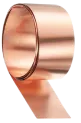


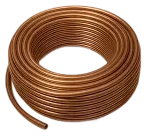
Oxygen-Free Copper Rod 8mm
8mm diameter · Copper with silver 99.99% · Conductivity over 101% IACS
Technical Specifications
| Diameter | 8 mm |
|---|---|
| Copper with Silver | Min. 99.99% |
| Oxygen | 0 to 5 ppm |
| Electrical Conductivity (20°C) | More than 101% IACS |
| Oxide Layer Thickness | 15 to 50 Å |
| Tensile Strength | 175 N/mm² |
| Elongation (A250) | More than 54% |
| Hydrogen Embrittlement Resistance | More than 10 bending cycles |
| Drawability (Thinning) | Down to 0.05 mm |
| Length per Coil | 10,000 to 11,000 m |
| Coil Inner Diameter | 95 cm |
| Coil Outer Diameter | 180 cm |
| Weight per Coil | 4 to 4.8 tons |
| Packaging | On a 1.8 × 1.8 m wooden pallet with plastic wrapping |
| Standard | ASTM B49-10 |
Product Description
Oxygen-Free Copper Rod is one of the purest grades of industrial copper, widely used in sensitive electrical, electronics, and telecommunications industries due to its very high electrical conductivity and exceptional purity.
Lorem ipsum dolor sit amet, consectetur adipiscing elit, sed do eiusmod tempor incididunt ut labore et dolore magna aliqua.
Applications
- Production of enameled wire for motors and transformers
- Cable manufacturing and high-voltage copper wire industry
- Electronics, telecommunications, and semiconductor industries
- Sensitive automotive components and hybrid systems
Key Advantages
- Electrical conductivity exceeding 101% IACS
- Resistance to hydrogen embrittlement
- High flexibility and drawability down to 0.05 mm
This section can be customized with more detailed product information, certifications, and application case studies.
Sourcing standard raw material in the wire and cable industry determines the final product quality and the efficiency of drawing production lines. The 8 mm copper wire rod, as the base size and primary entry point in the electrical industry’s supply chain, plays a key role in determining the electrical conductivity and mechanical properties of downstream products. Insufficient purity or structural oxygen content in this size can lead to frequent breaks during the wire-drawing process and increased production waste. In this guide, drawing on metallurgical indicators and international standards, we examine the technical dimensions, structural differences between ETP and OFC, and the factors affecting the pricing of 8 mm rod, to make the decision-making process clearer for industrial buyers.
Comprehensive Buying Guide for 8 mm Copper Wire Rod
In this section, we cover all the key factors you need to know before selecting and purchasing 8 mm rod based on your production line’s requirements.
What Is 8 mm Rod, and Why Is It Considered the Base Size for the Wire and Cable Industry?
The 8 mm copper wire rod is a round cross-section product from hot rolling or continuous casting, used as the input feedstock in wire and cable factories. The 8 mm diameter is an optimal point in terms of metallurgical properties, allowing continuous drawing down to very fine diameters (as low as 0.05 mm) without requiring multiple heat treatment steps.
What’s the Difference Between OFC and ETP 8 mm Copper Wire Rod?
The main difference between these two types of rod lies in their structural oxygen content and casting method:
- ETP Rod (Electrolytic Tough Pitch): Contains 100 to 400 ppm of oxygen and is used for producing general-purpose electrical wire and cable, but has limitations in processes sensitive to hydrogen embrittlement.
- OFC Rod (Oxygen-Free Copper): Manufactured using an oxygen-free casting method (oxygen below 10 ppm) with 99.99% purity, resulting in electrical conductivity above 101% IACS and exceptional flexibility during intensive drawing operations.
To verify the authenticity of a delivered batch, the buyer’s specifications must always be checked against reference standards.
Technical Specifications and Purity Standard (99.9% per EN 1977 / ASTM B49)
Standard 8 mm rod must comply with the international ASTM B49 or EN 1977 requirements, the main indicators of which include:
- Chemical purity: Minimum 99.90% for ETP grade and minimum 99.99% for OFC grade.
- Electrical conductivity: Minimum 100% IACS for ETP and above 101% IACS for OFC at 20°C.
- Elongation: Minimum 30–35% relative elongation before breaking.
- Surface quality: Free of structural defects, burrs, and deep oxidation.
8 mm Copper Wire Rod Price and the Factors Behind It
Accurately estimating price and understanding pricing mechanisms helps you manage raw material sourcing costs. Various factors affect the final purchase price of 8 mm copper wire rod, which we’ll examine below.
The Impact of the Commodity Exchange Rate and Global LME Price
The base price of 8 mm rod is directly a function of two main indicators:
- The global copper rate on the London Metal Exchange (LME)
- The day’s copper cathode price on the Iran Mercantile Exchange (based on exchange rates and LME)
Any fluctuation in these two markets immediately changes the final price of the rod. The production structure of this base size creates a clear price difference compared to other, thinner copper sections and sizes.
Why Is the Price Margin for 8 mm Rod Lower Relative to the Base Copper Rate?
Due to its high-volume continuous casting process (Properzi or Upcast) and limited forming steps, 8 mm rod has the lowest processing cost. As a result, its selling price is very close to the copper cathode price, with only a marginal manufacturing profit.
The buyer’s order volume also determines the structure of the final invoice and how additional costs are calculated.
The Difference Between Bulk (Tonnage) and Retail Purchase Pricing
Pricing and payment methods based on purchase volume are handled in two ways:
| Purchase Method | Pricing Basis | Buyer Notes |
| Tonnage (Bulk) Purchase | Commodity exchange price + standard processing fee | Delivered as 2–4 ton coils with certificate and analysis sheet |
| Retail (Per-Kilogram) Purchase | Day’s free market price + storage fee | Suitable for workshops and projects with limited consumption volume |
Main Industrial Applications of 8 mm Copper Wire Rod
The rod’s type and 8 mm cross-section determine the scope of its use across upstream and downstream sectors of the power industry.
- Feeding primary drawing machines (RBD): Used as the main input for conversion into intermediate and fine sizes during the drawing process.
- Manufacturing stranded and multi-strand conductors: The base rod is used to produce copper strands, which are then formed into multi-strand conductors (flexible and semi-flexible).
- Producing copper conductors for industrial equipment: Used in production lines for parts and conductors that require high conductivity, good formability, and specific dimensions.
- Producing busbars and copper bars: Copper is used as raw material for manufacturing busbars and conductive components used in switchgear panels and power distribution equipment.
- Manufacturing conductors for power equipment: Used in the production chain for conductors used in transformers, generators, and power electrical equipment.
- Grounding and bonding systems: Used in grounding connection paths, grounding wells, and lightning protection, provided the cross-section meets design requirements.
- Manufacturing electrical parts and connectors: Used as raw material for producing terminals and copper connectors after machining or forming.
Sales Methods and Supply Forms of 8 mm Copper Wire Rod
Matching the physical form of the shipment and the sales pattern to the buyer’s production line infrastructure reduces storage costs and production waste.
- Industrial Coil: Packaged as continuous 2–4 ton coils (on pallets) with no length welds, designed for continuous feeding of primary drawing machines in factories.
- Straight Rod Supply: Cut to specific lengths (usually 3 or 6 meters) for use in machining lines, busbar manufacturing, and electrical components.
- Supply by Metallurgical Condition (Hard/Soft): Delivered either as-cast (hard) or annealed (soft), depending on the downstream forming process.
- Tonnage and Credit Sales (B2B): Designed for large industries, based on the official commodity exchange rate, along with letter of credit (LC) issuance or bank guarantee.
- Retail and Cash Sales (Workshop): Supplying smaller quantities (by the kilogram) based on the day’s free market price, to serve small projects and workshops.
Steps to Purchase 8 mm Copper Rod from Ebtekar Mes Parsian Industrial Group
Sourcing directly from the manufacturer ensures financial transparency and technical certification before loading, for industrial units.
- Technical consultation and inquiry: EMP’s metallurgical experts assess your production line requirements and determine the appropriate base type (OFC or ETP).
- Issuing a transparent pro forma invoice: Accurately stating the price based on the day’s commodity exchange/market rate, requested weight, and delivery terms.
- Providing a quality certificate: Sending the lab analysis sheet (spectrometry and electrical conductivity) along with the pro forma invoice or the shipped batch.
- Production and loading: Preparing the coils at the Rafsanjan factory or delivery from the central office and warehouse in Tehran.
- Shipping and support: Delivering the shipment to all locations across the country, with guaranteed purity consistency and technical support throughout the usage process.
Need Expert Technical Consultation or a Current Price Quote?
To receive a pro forma invoice, place tonnage orders, or get advice on choosing the right metallurgical base for your production line, contact the technical experts and consultants at Ebtekar Mes Parsian Industrial Group (EMP) today.
Frequently Asked Questions
- Why is OFC rod preferred for producing thin wires?
Because of its oxygen content below 10 ppm, the rate of micro-breaks at high drawing speeds is minimized, and the final product’s electrical conductivity will be above 101% IACS. - What’s the main difference between Upcast and Properzi casting for 8 mm rod?
The Upcast method is used to produce deoxidized (OFC) rods with high purity (99.99%), while the Properzi method is more commonly used for high-volume production of ETP rods. - Can a lab analysis sheet (spectrometry) be provided with the shipment?
Yes; all shipments from Ebtekar Mes Parsian Industrial Group (EMP) are delivered with a valid lab certificate and a guarantee of purity consistency.